
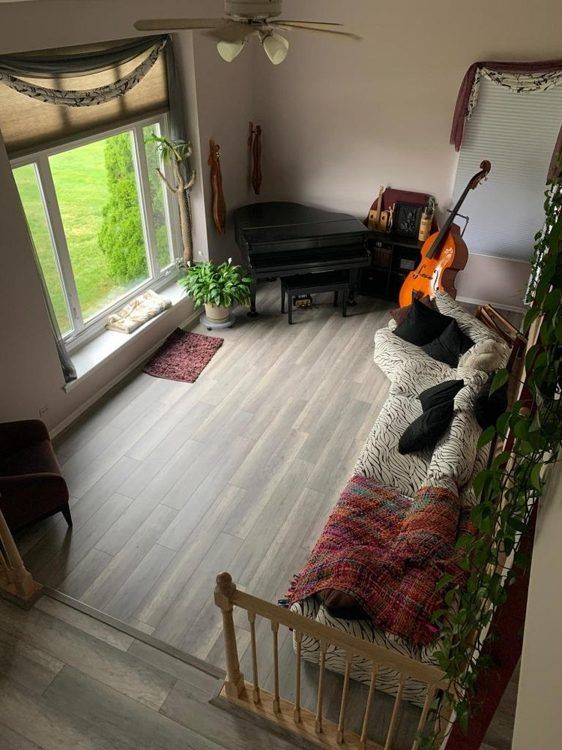
Tile-look laminate gives you the look of stone or ceramic on a click-together floor that’s warmer and softer underfoot than real tile. It can be a smart choice for a kitchen or an entry, and the wrong one for a bathroom with a shower.
Here’s where it works, where it doesn’t, and how it stacks up against real tile and luxury vinyl plank.
What Tile-Look Laminate Is
Laminate is a fiberboard core with a printed image layer on top, protected by a clear melamine wear layer. Tile-look laminate simply prints a stone or ceramic design instead of wood grain.
It comes in more than one format. Some are plank shaped, like Pergo’s Portfolio with WetProtect in Graphite Slate, a 7 1/2 by 47 1/4 inch board with an embossed stone look sold at Lowe’s. Others come in tile-sized formats, and Shaw’s installation library includes a guide for a 16 inch tile-look laminate.
There’s no real grout. The grout look comes from the print, beveled edges or texture, so there’s nothing to seal or scrub.
Where Tile-Look Laminate Works
A waterproof line opens up most of the rooms where people want a tile look.
- Kitchens, where it’s easier on your feet and on dropped dishes than tile
- Entryways and mudrooms, paired with walk-off mats for grit
- Laundry rooms, as long as there’s no floor drain in the room
- Powder rooms without a tub or shower
- Basements that stay dry, over a proper moisture barrier
Pergo’s Graphite Slate listing, for example, recommends its waterproof floors for kitchens, baths, laundry rooms and mudrooms, and says they can go in basements.
Where Real Tile or LVP Is Better
Laminate still has a wood fiber core, and its water ratings come with conditions. Mohawk Home’s FAQ for its waterproof laminate, for example, excludes standing water, flooding and appliance leaks, and says not to install it in a room with a floor drain.
That rules out a few spaces.
- Full bathrooms with a tub or shower that splashes regularly
- Rooms with a floor drain or a sump pump
- Three-season rooms and other spaces without steady heating and cooling, since makers like Shaw expect normal indoor temperature and humidity
Tile-Look Laminate vs Real Tile
| Tile-look laminate | Porcelain or ceramic tile | |
|---|---|---|
| Water | Waterproof lines handle spills, with conditions | The tile won’t swell, though grout needs care |
| Feel underfoot | Softer and warmer, over a pad | Hard and cool |
| Installation | Clicks together and floats | Set in mortar and grouted |
| Repairs | Replace damaged planks | Replace cracked tiles |
| Subfloor | Must be flat, and can float over some existing floors | Needs a rigid, flat base |
| Typical cost | Lower | Higher |
Real tile is the tougher choice for wet rooms and the more permanent one. Tile-look laminate wins on comfort and installation time in most dry rooms, and the national cost guides we checked put installed tile above installed laminate.
Within laminate, tile looks can cost a little more. HomeGuide’s cost guide lists tile-look laminate above wood-look laminate for materials.
Tile-Look Laminate vs LVP
Luxury vinyl plank is laminate’s closest rival, and it comes in tile looks too. The biggest difference is the core.
- Laminate uses a fiberboard core made from wood fibers.
- LVP uses a vinyl-based core, including rigid SPC and WPC types.
That’s why vinyl handles water better. Mohawk’s rigid vinyl warranty calls the product 100% waterproof against topical water, though it still excludes flooding and water coming from below.
Laminate holds its own on scratches. Its melamine surface is very hard, and Costco’s flooring guide calls laminate one of the most scratch-resistant and impact-resistant materials available.
Installed costs overlap. This Old House’s 2026 guide puts laminate at roughly $5 to $12 per square foot installed, and Fixr’s 2025 guide puts most LVP projects at about $5 to $12. Both are typical national ranges that vary by product and job.
For a bathroom, LVP is usually the safer pick. For a kitchen or an entry where scratches worry you more than water, tile-look laminate holds up well.
Installing Tile-Look Laminate
Tile-look laminate goes down like any other laminate. It clicks together and floats, with an expansion gap at the walls that trim covers.
It can often go over an existing hard floor, including old tile, as long as that floor is sound, flat and dry. Angi notes that laminate can go over most floors except carpet. Deep grout lines or loose tiles need attention first, or the new floor can flex over them.
Check the underlayment rules for your product. Pergo’s Graphite Slate, for example, needs a separate underlayment, and the listing recommends Pergo’s own. Over concrete, plan on a moisture barrier.
If you have radiant floor heat, look for a product rated for it. Home Depot’s laminate filters include radiant heat compatibility, and makers like Pergo ask you to check with them about heated floors before you install.
Caring for Tile-Look Laminate
With no grout, cleaning is simpler than with real tile. Sweep or vacuum with the hard floor setting, then use a barely damp mop and a laminate cleaner.
Skip steam mops, wax and polish, which laminate makers warn against. Wipe up spills promptly, even on a waterproof line, and use walk-off mats at doors.
How to Choose a Tile-Look Laminate
- Pick AC4 for kitchens and entries, where grit and dropped items are constant.
- Choose a waterproof line for any room that sees spills, and read its sealing rules.
- Look at texture in person, since an embossed stone surface reads more like real tile than a flat print.
- Check the plank or tile size against your subfloor, because larger formats are less forgiving of dips.
- View samples in daylight and at night, since printed stone can look different under warm bulbs.
Lowe’s laminate filters even include a tile look style, which makes it easy to compare options side by side. Still deciding whether laminate suits your home at all? Our honest guide to laminate covers the tradeoffs, and our guide to waterproof flooring for bathrooms helps with wet rooms.
Quality Installs is a family-owned flooring installer in Glenview that installs laminate, hardwood and vinyl plank floors. Our laminate flooring installation page explains how we handle laminate projects.