
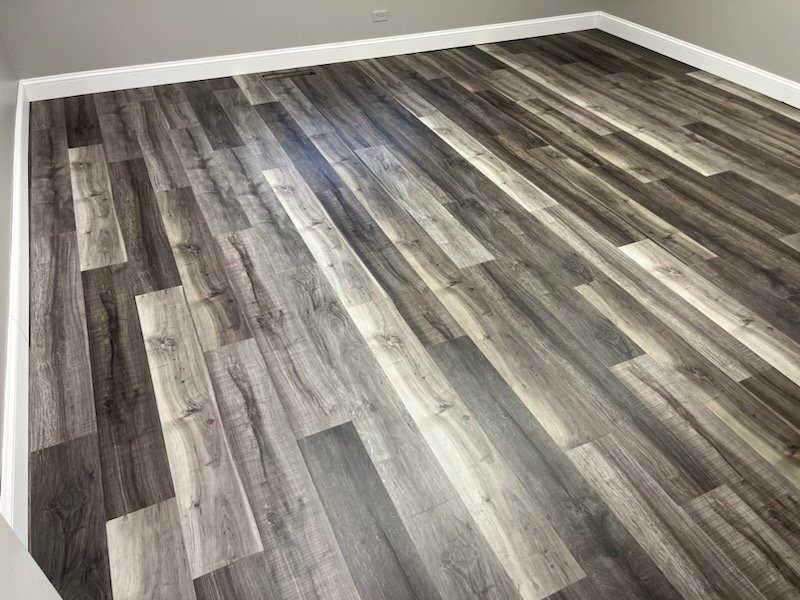
Laminate is one of the more affordable floors to have professionally installed, but two quotes for the same room can still land far apart. The gap usually comes down to the product, the condition of the floor underneath and what each installer included.
Below are typical national ranges from current cost guides, followed by the factors that move a quote up or down. Treat every number here as a typical range that varies by region, home and product, not as a quote.
Typical National Cost Ranges
This Old House’s 2026 laminate cost guide puts materials at about $1 to $4 per square foot, with an average near $2.50, and professional labor at about $4 to $8. Together, that’s roughly $5 to $12 per square foot installed.
Angi’s 2025 data lands in a similar place, at about $3 to $13 per square foot installed. Angi reports an average project of about $2,991, with most falling between $1,472 and $4,645.
Here’s how the This Old House ranges scale with the size of the job.
| Area | Typical installed range (2026) |
|---|---|
| 100 square feet | $500 to $1,200 |
| 200 square feet | $1,000 to $2,400 |
| 500 square feet | $2,500 to $6,000 |
| 1,000 square feet | $5,000 to $12,000 |
Prices in the Chicago suburbs can differ from national figures, so use these to sanity check a quote rather than predict one.
What Drives the Price
The Laminate You Pick
Thicker planks and higher AC ratings cost more. In Angi’s 2025 numbers, 7 mm laminate runs about $0.90 to $1 per square foot for materials, while 12 mm runs about $2.30 to $6.
Waterproof lines, attached pads and extra scratch or sound features also raise the material price. An attached pad can pay back part of that, since you won’t buy and install separate underlayment.
Labor and Layout
A big open rectangle goes fastest. Closets, hallways, angled walls, lots of doorways and stairs all mean more cuts and more time, and cost guides single out stairs as a labor add.
Angi estimates labor at 20% to 50% of the total project. It also prices glued installs above click-lock ones, at about $7 to $11 per square foot versus $5 to $9.
Tearing Out the Old Floor
If the old floor has to come out, someone has to remove it and haul it away. This Old House lists professional removal at about $50 to $70 per hour, and Angi estimates roughly $400 to $600 to clear 200 square feet.
Subfloor Repair and Flattening
Click-together laminate needs a flat base, or the joints can flex and separate. Shaw’s installation guide, for example, calls for a subfloor that’s flat within 3/16 inch over 10 feet.
Repairs are the hardest cost to predict before someone looks at the floor. This Old House puts subfloor repair or replacement at about $1.50 to $7 per square foot.
Underlayment and Moisture Barriers
Planks without a pad need underlayment, which This Old House prices at about $30 to $50 per 100 square foot roll. Over concrete, manufacturers typically require a polyethylene vapor barrier as well, and This Old House puts a separate moisture barrier at about $35 per roll.
Trim, Transitions and Furniture
Laminate floats, so it needs a gap around the edges that baseboard or quarter round covers. You may also need transition strips at doorways and wherever laminate meets another floor.
Moving furniture adds a little too. Angi lists about $20 to $50 per room when the installer handles it.
Extra Material for Cuts
Every room loses some planks to cuts. Angi recommends ordering about 10% extra, and odd-shaped rooms or diagonal layouts can need more.
A Sample Budget for One Room
To see how the pieces add up, take a 200 square foot bedroom with an old floor coming out and a subfloor that needs no repairs. Using the national ranges above, a typical budget looks something like this.
| Item | Typical range |
|---|---|
| Laminate, at $1 to $4 per square foot | $200 to $800 |
| Labor, at $4 to $8 per square foot | $800 to $1,600 |
| Underlayment, two rolls if the planks have no pad | $60 to $100 |
| Removing the old floor | $400 to $600 |
| Moving furniture | $20 to $50 |
That lands between roughly $1,500 and $3,150 before trim, transitions or any subfloor work. It’s an illustration built from national ranges, not a quote, and your own room could come in above or below it.
Doing it yourself skips the labor line. Angi puts a DIY laminate project at about $800 to $3,500, but you’ll need the tools, the time and a flat subfloor to make it worth it.
How to Compare Estimates
The cheapest quote isn’t always the cheapest job. Ask every installer to put the same items in writing so you can line them up.
- The product, with brand, color and square footage, plus the waste allowance
- Removal and disposal of the old floor
- Subfloor prep, including any moisture testing
- Underlayment or a vapor barrier, if the product needs one
- Trim, quarter round and transitions
- Furniture moving and cleanup
- A start date, an estimated finish date and the payment schedule
If one quote is much lower, check which of these it leaves out. Our guide to hiring a laminate installer covers the questions to ask next.
Ways to Keep the Cost Down
You can trim the bill without cutting corners on prep.
- Clear the rooms yourself before the crew arrives. Angi also suggests pulling baseboards yourself to save on labor.
- Do several rooms at once. Cost guides note that installers may lower the per square foot rate on bigger jobs.
- Pick a standard plank width. Wide planks need a flatter subfloor, which can add prep.
- Don’t skip moisture testing or flattening. A cheaper install that fails early costs more in the end.
When Laminate Is the Right Budget Pick
Laminate usually costs less installed than hardwood. This Old House’s 2026 hardwood guide lists about $6 to $18 per square foot installed, against $5 to $12 for laminate.
Price isn’t the only difference, though. Our laminate vs hardwood comparison walks through durability, water, refinishing and resale.
Quality Installs is a family-owned flooring company founded in 2004 by Bob Leibrandt, and our estimates are free. Learn more about our flooring installers in Glenview, or see how we handle laminate projects on our laminate flooring installation page.