
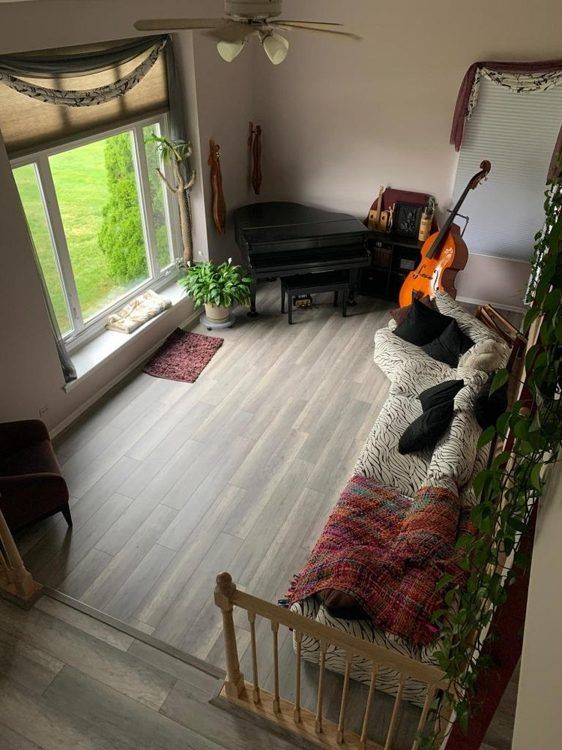
Vinyl plank has become the default answer for a lot of homes, and for many of them it’s the right one. It isn’t right for everyone, though, and the best time to find that out is before the planks go down.
What follows is a straight look at where vinyl plank wins, where it falls short and who should pick something else. Quality Installs installs hardwood, laminate and vinyl plank, so we don’t have a reason to push one over the others.
The Quick Answer
| If This Sounds Like You | Vinyl Plank Is | Also Consider |
|---|---|---|
| Kitchen, bath, laundry room or basement | A strong fit | Porcelain tile for a bathroom |
| Dogs, kids and lots of spills | A strong fit with a thick wear layer | Laminate for the dry rooms |
| You want real wood that can be refinished | A weak fit | Hardwood |
| A wood look on a budget in dry rooms | A good fit | Laminate |
| A sunroom or a wall of unshaded windows | Possible, with care | Shades and a product rated for heat |
| You’d rather avoid plastics at home | A weak fit | Hardwood |
Where Vinyl Plank Wins
It Handles Water
Rigid core vinyl plank, SPC or WPC, is waterproof. Spills, pet accidents, wet boots and a damp mop won’t swell it, which is why it shows up in so many kitchens, baths, laundry rooms and basements.
Waterproof planks don’t make the subfloor waterproof. They still give you far more margin than wood or laminate.
It Takes Everyday Wear
The clear wear layer on top protects the printed look. Wear layers commonly run from about 6 mil to 20 mil and up, and 20 mil is a solid choice for homes with pets or heavy traffic. SPC cores add dent resistance on top of that.
It’s Comfortable
Vinyl feels warmer underfoot than tile or bare concrete. WPC cores are softer and quieter, and many planks come with an attached pad that cuts noise.
It’s Easy to Clean
A dust mop or a vacuum with the beater bar off, then a damp mop with a pH-neutral cleaner. There’s no waxing, no refinishing and no sealing.
It’s Flexible About What’s Underneath
Floating vinyl can go over concrete, plywood and some existing floors, such as a single layer of sheet vinyl that isn’t heavily cushioned. It still needs a flat, sound subfloor, and it shouldn’t go over carpet.
It Usually Costs Less Than Hardwood
Vinyl plank generally costs less than solid hardwood, though prices swing widely from one product line to the next. Wear layer thickness, core type and extras like an attached pad all affect the price.
Where Vinyl Plank Falls Short
It Can’t Be Refinished
Hardwood can be sanded and refinished when it wears. Vinyl can’t. A worn or damaged plank gets replaced, which is easy with a click floor if you saved a spare box and harder if the color has been discontinued.
It Dents and Scratches
Heavy furniture, dragged appliances and dropped pans can dent or gouge vinyl, especially with a thin wear layer. Wide felt pads under furniture help, and so does a sheet of plywood to walk an appliance across when it has to move.
Sun and Heat Can Be Hard on It
Long exposure to direct sun can discolor vinyl and make it expand. Rooms that run hot, like sunrooms, need a product rated for it and sometimes a bigger expansion gap. One maker calls for 5/8 inch instead of the usual 1/4 inch in rooms that get above 85 degrees.
Rubber Can Stain It
Rubber or latex backed mats can discolor vinyl, and that stain is often permanent. It’s an easy problem to avoid once you know about it.
It’s Plastic
Vinyl plank is made from layers of PVC. If you’d rather have natural materials in your home, that alone may settle it.
If indoor air quality is the concern, look for FloorScore certification. It tests flooring for emissions of 35 volatile organic compounds using California’s Section 01350 method.
Waterproof Isn’t Flood-Proof
A waterproof floor won’t fix a wet basement or survive a flood unharmed. Water can reach the subfloor at seams and edges, and many flooring warranties don’t cover the subfloor or the structure around it.
Who Should Choose Something Else
Pick Hardwood If
You want real wood, you like the idea of refinishing instead of replacing, and the rooms are dry, like living rooms, dining rooms and bedrooms. Our guide to whether hardwood flooring is right for you covers the tradeoffs.
Pick Laminate If
You want a hard, scratch-resistant wood look in dry rooms and you’ll wipe up spills right away. Laminate’s water claims usually stop at everyday spills, so keep it out of full baths and basements that see water. Our guide to whether laminate flooring is right for you goes deeper.
Pick Tile If
You want a heated bathroom floor, a surface that can sit in water, or the look of real stone. Porcelain tile absorbs almost no water, at 0.5 percent or less by definition, and it’s the classic pairing with radiant heat.
How to Shop If You Go With Vinyl
- Compare wear layers, not total thickness.
- Choose the core. SPC for dent resistance, WPC for comfort and quiet.
- Read the installation guide for moisture and temperature limits before you buy, especially for a basement.
- Check the warranty’s water language. Know what’s covered and what’s excluded.
- Look for FloorScore if emissions matter to you.
- Bring samples home. Look at them in your own light, next to your cabinets and trim.
Quality Installs is a family-owned team of flooring installers in Glenview, founded by Bob Leibrandt in 2004. If vinyl plank is your answer, our vinyl plank installation page explains how we handle it.