
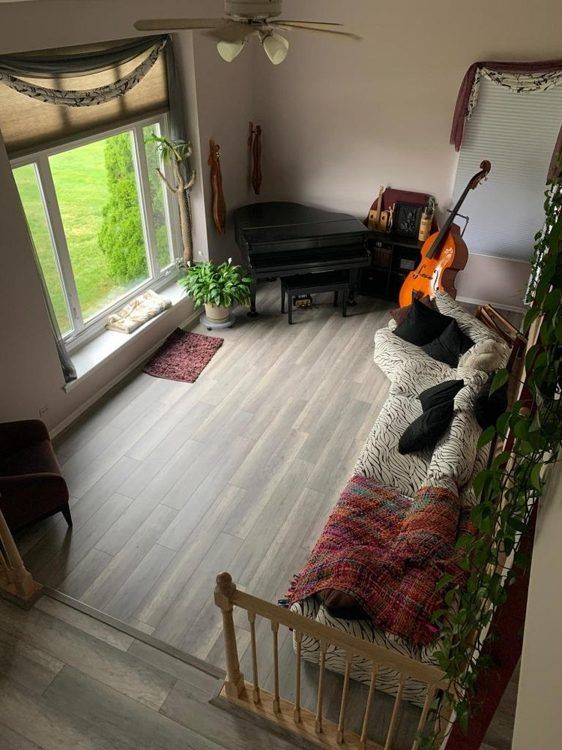
Resilient flooring sounds like a sales term, but it’s a real category. The Resilient Floor Covering Institute, as quoted by flooring maker Mannington, defines it as a non-textile floor that provides underfoot comfort and bounces back from repeated traffic or compression.
In plain terms, resilient floors are firm but have a little give. That puts them between soft floors like carpet and hard floors like tile, stone and hardwood. The four main types are vinyl, linoleum, rubber and cork.
Laminate isn’t on the list. Mannington explains that laminate is too wood-based to have that bounce-back quality.
What Resilient Floors Have in Common
Mannington describes most resilient floors as a mix of fillers, binders, resins and color pigments. Fillers can include ground wood, limestone or other minerals, and the binders and resins hold everything together.
Mannington credits the category with durability, easy cleaning, scratch resistance and comfort underfoot, and notes it’s common in schools, healthcare buildings, stores, gyms and offices.
The Four Types at a Glance
| Type | Made From | Water | Feel Underfoot | Common Home Uses |
|---|---|---|---|---|
| Vinyl | Synthetic PVC-based layers | Many plank and sheet products are waterproof | Firm with some give | Kitchens, baths, basements, laundry rooms |
| Linoleum | Linseed oil, rosin, wood flour, limestone, jute | Needs a protective finish | Firm and warm | Kitchens, playrooms |
| Rubber | Natural or synthetic rubber, often recycled tires | Water resistant, won’t mold | Cushioned | Home gyms, playrooms, under washers |
| Cork | Bark of the cork oak | Varies, standard planks don’t like water | Soft, warm and quiet | Bedrooms, family rooms, home offices |
Vinyl
Vinyl is the most popular resilient floor, according to Mannington. It comes as sheets, tiles and planks, and the category covers solid vinyl products like luxury vinyl tile and plank as well as the vinyl composition tile common in commercial buildings.
Luxury vinyl plank pairs a printed design layer and a clear wear layer with a core. Rigid core versions bond that top layer to a stiff, waterproof core, which makes them a common choice for kitchens, bathrooms and basements. They’re waterproof from the top, but installation guides like Lifeproof’s are clear that the floor isn’t a moisture barrier, so concrete still needs a moisture check.
Sheet vinyl is the budget pick, and Fixr’s 2025 cost guide puts most installs at $3 to $7 per square foot. Our post on sheet vinyl installation cost covers what changes that number.
Quality Installs installs luxury vinyl plank, so it’s the resilient floor we know best. Our luxury vinyl plank installation page covers that work.
Linoleum
Linoleum is the original resilient floor and predates vinyl. People often call any sheet floor linoleum, but the two are different materials.
Real linoleum is made mostly from natural ingredients. Forbo’s raw materials fact sheet for its Marmoleum line lists linseed oil, tall oil, gum rosin, wood flour and jute as renewable ingredients making up about 62 percent of the product, with limestone filler at about 23 percent. The only non-bio-based materials, at about 3 percent, are the color pigments and factory finish.
Archtoolbox describes linoleum as very long-lasting and sold mainly as sheet goods, with tiles prone to lifting at the corners. It needs a top coat and occasional refinishing to stay protected.
Linoleum suits kitchens and playrooms for homeowners who want natural materials and don’t mind some upkeep.
Rubber
Rubber flooring can be natural or synthetic, and much of it is made from recycled tires. It comes as tiles, rolls and mats, including interlocking tiles that fit together like puzzle pieces.
Hunker’s homeowner guide lists its strengths as durability, comfort, noise reduction, stain resistance and the fact that it won’t mold. The downsides are a rubbery smell, a higher price than many floors, and a look that doesn’t always blend with the rest of a house. Archtoolbox notes it has become a standard in commercial and institutional buildings.
At home, rubber makes the most sense in a gym, a playroom or under a washer and dryer. Our guide to garage gym flooring covers rubber mats and tiles in more detail.
Cork
Cork comes from the bark of the cork oak. This Old House explains that harvesting doesn’t hurt the tree, which regrows its bark roughly every nine years, and leftover scraps are ground into granules for tiles and planks.
Its air cells make cork a natural insulator, so it feels warm, cushions your feet and quiets a room. Dents tend to recover on their own, but cork is prone to scratching, especially with pets. It lightens in direct sun, and most cork needs a fresh coat of water-based polyurethane every 3 to 10 years.
Water is the big question. Standard floating cork planks have a fiberboard core that can absorb water at the seams, which rules them out for bathrooms. Some click planks use a waterproof core and are rated for baths and laundry rooms, so check the product before assuming.
How to Choose
- Choose vinyl for kitchens, baths, basements and laundry rooms, or anywhere water and busy traffic meet.
- Choose linoleum if you want natural materials and don’t mind periodic refinishing.
- Choose rubber for a home gym, playroom or utility space where cushion and toughness matter more than looks.
- Choose cork for bedrooms, offices and family rooms where warmth and quiet count.
For linoleum, rubber or cork, look for an installer who specializes in that material. Quality Installs is a family-owned flooring installer in Glenview that installs hardwood, laminate and luxury vinyl plank in homes and businesses.