
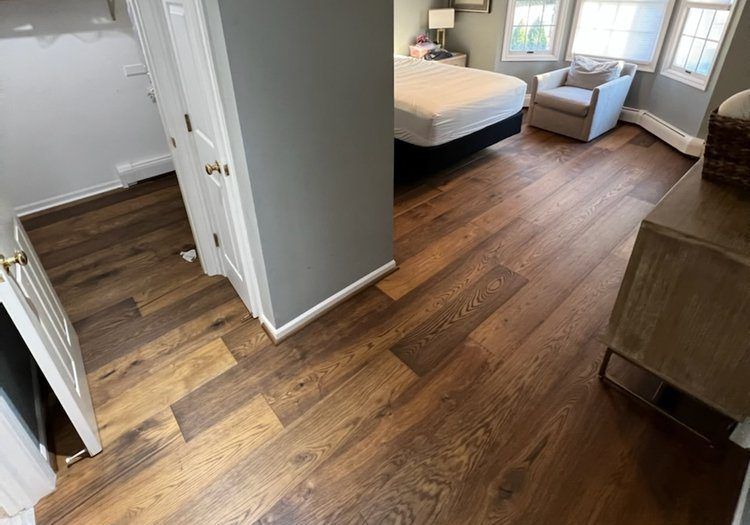
Pine is the floor in a lot of very old houses, and it ages unlike anything else. It warms in color, collects dents and turns into the kind of worn, golden floor people try to fake with distressing.
It’s also soft, and the word pine covers woods with very different hardness. Knowing which pine you’re looking at is most of the decision.
Pine Is a Softwood With a Big Range
Botanically, pine is a softwood, but it’s milled into tongue and groove boards and installed like any solid wood floor. The real question is which pine, because hardness varies a lot from one to the next.
| Pine Type | Janka Hardness (lbf) |
|---|---|
| Eastern white pine | 380 |
| Longleaf pine | 870 |
| Antique heart pine, reclaimed | About 1,225 |
| Red oak, for comparison | 1,220 |
The white pine, longleaf and red oak figures come from The Wood Database. The heart pine figure comes from reclaimed heart pine suppliers, and one of them calls it anecdotal, so treat it as a ballpark.
The Main Types of Pine Flooring
Eastern White Pine
Eastern white pine is the soft, pale pine of old New England farmhouses. Old House Online notes that white pine planks are still in service in New England homes more than 250 years old.
At 380 lbf, it’s about a third as hard as red oak. The Wood Database describes light brown heartwood, sometimes with a reddish hue, and pale yellow to nearly white sapwood, and it notes that the color darkens with age.
Southern Yellow Pine
Southern yellow pine is a group, not one tree. The NWFA lists longleaf, shortleaf, loblolly and slash pine, and describes heartwood that runs from light yellow-orange to reddish brown, with patterns from clear to knotty.
It’s easy to find and noticeably harder than white pine. The Wood Database puts longleaf pine at 870 lbf.
Heart Pine
Heart pine is flooring cut mostly from the dense heartwood of original-growth longleaf pine. Suppliers grade it by heartwood content, from about 75 percent in character grades to 95 percent or more in clear grades, and one supplier’s clear grade calls for eight or more growth rings to the inch.
It’s prized because it’s so much harder than modern pine. One heart pine supplier compares its hardness to red oak.
Its color changes fast, too. The NWFA notes that antique heart pine is yellow when first cut and turns a deep pinkish tan to warm reddish brown within weeks because of its high resin content.
How the log was sawn changes the look as well. The NWFA notes that plainsawn heart pine shows a swirled grain, while rift or quartersawn boards are mostly pinstriped, a tighter, quieter look often sold as vertical grain.
Reclaimed Pine
Reclaimed pine is salvaged from older buildings or recovered timber and milled again into flooring. Depending on the grade, expect small nail holes, pin knots, face checks and other marks of a long first life.
Supply is tight. The NWFA lists antique heart pine as having limited availability, and The Wood Database notes that natural longleaf stands have largely been replaced by plantations of loblolly and slash pine. That’s why true antique heart pine is a specialty product.
Dents, Scratches and Patina
Every pine floor dents. On white pine, a dropped can, a high heel or a chair leg will leave a mark you can see.
Over the years, those marks soften into a lived-in surface. That’s either the charm or the problem, depending on what you want from a floor. If you need a floor that stays crisp, pine will frustrate you.
A lower sheen helps either way. The NWFA notes that the less sheen a floor has, the less you’ll notice small scratches and normal wear.
If a pine floor ever needs sanding down the road, choose a finisher who knows the wood. The Wood Database notes that longleaf pine’s resin can gum up tools and clog sandpaper.
Color is part of the patina. Shaw Floors notes that light woods like pine may darken over time, and the finish matters as well. The NWFA describes oil-based finishes as amber in color and water-based finishes as normally clear, so an oil-based finish pushes pine warmer still.
Honest Pros and Cons of Pine Flooring
Pros
- Warm color that deepens with age
- A look that suits old houses, farmhouse rooms and cabins
- Wide boards, with some reclaimed heart pine offered up to 12 inches wide
- Heart pine density in the range of red oak, by supplier figures
Cons
- Soft pines dent and scratch easily
- Sapwood stays yellow and can carry blue-black sap stain, so boards vary
- Wide boards move more, so dry winters can open bigger gaps
- Antique heart pine is limited, which makes matching or adding on harder
Where Pine Makes Sense
Pine works best where you’ll enjoy the aging. Bedrooms, dens and living rooms with lighter foot traffic suit soft pine, and heart pine can handle busier spaces.
Think twice about white pine in a kitchen, mudroom or entry, or in a house with big dogs. If you want a warm, rustic floor that resists dents, hickory gives you color and character with far more hardness. Our hickory flooring guide shows how it compares.
Quality Installs is a family-owned flooring company in Glenview with more than 10,000 projects completed, and you can read about our hardwood flooring installation work.
Any wide pine floor needs steady humidity. Wood Floor Business notes that a 5-inch plank shrinks about twice as much as a 2 1/4-inch strip for the same change in moisture, and plenty of pine floors run wider than that. The NWFA recommends 30 to 50 percent humidity year-round, and our post on how to maintain your hardwood floors explains how to manage it through a Chicago-area winter.