
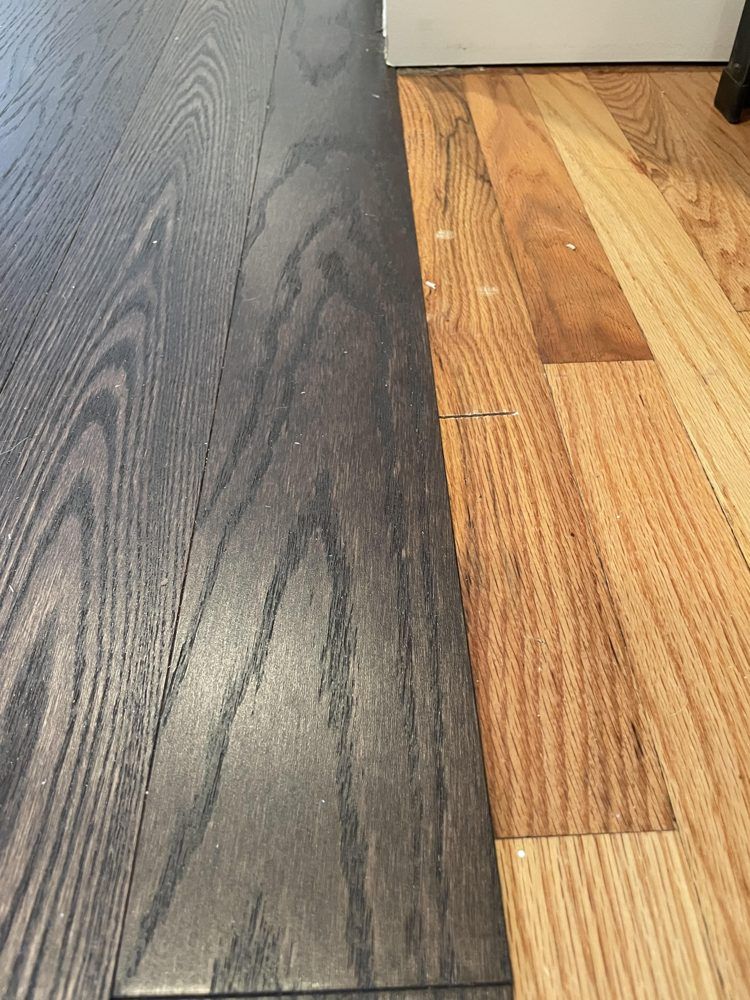
Red oak is the floor a lot of people picture when they hear the word hardwood. It has bold grain, a warm tone and a reputation for being easy to live with.
It’s also constantly compared with white oak, and the two really are different woods. Here’s what red oak looks like, how hard it is, how it takes stain and when white oak makes more sense.
What Red Oak Looks Like
The Wood Database describes red oak heartwood as light to medium brown, commonly with a reddish cast, and a coarse, uneven texture. Flooring maker Mullican describes a subtle pink tint that warms toward red under a natural finish.
The grain is the star. Red oak has strong grain lines that give a floor movement, and Mullican notes that its prominent grain hides normal wear and tear.
Like other oak, it comes in grades. Under NWFA rules, Clear is the most uniform, Select allows more natural color variation, and No. 1 and No. 2 Common add knots, streaks and character.
How Hard Is Red Oak
The Wood Database lists northern red oak at 1,220 lbf on the Janka scale, which measures the force needed to press a steel ball into the wood. Flooring references, including Wood Floor Business, often use 1,290, so you’ll see both numbers.
| Species | Janka Hardness (lbf) |
|---|---|
| Hickory (shagbark) | 1,880 |
| Hard maple | 1,450 |
| White oak | 1,350 |
| White ash | 1,320 |
| Red oak | 1,220 |
| Black walnut | 1,010 |
The figures in this table are from The Wood Database. Red oak lands in the middle of the domestic pack, hard enough for most rooms and still soft enough to dent under a dropped pot.
Red Oak vs White Oak
The two oaks look similar from across a room, but they differ in color, grain and how they handle water.
| Trait | Red Oak | White Oak |
|---|---|---|
| Color | Pink to reddish brown | Tan to brown, often with an olive or gray cast |
| Grain | Bolder and more prominent | Smoother, with more mineral streaks |
| Janka (lbf) | 1,220 | 1,350 |
| Pores | Open | Plugged with tyloses |
| Water | Can stain and discolor when wet | Slightly more water resistant |
The pores make the biggest practical difference. White oak heartwood has tyloses, small bubble-like growths that fill its large pores, while red oak heartwood lacks them.
The Wood Database notes that red oak can discolor when it stays in contact with water and lacks the rot resistance of white oak, which is why white oak gets used for boats and barrels. Neither one is waterproof as a floor. White oak just gives you a little more margin around sinks and doors.
How to Tell Which Oak You Have
If you’re adding on to an existing floor or matching one, it helps to know which oak is already there.
- Color. Red oak leans pink or red. White oak leans tan, olive or gray.
- End grain. Look at a cut end, such as the edge of a floor vent opening. Open pores point to red oak, and plugged pores point to white oak.
- Ray flecks. The Wood Database notes that red oak’s rays rarely run longer than an inch on the face of a board, while white oak’s can.
How Red Oak Takes Stain
Red oak takes stain well, according to both The Wood Database and Wood Floor Business. That flexibility is one reason it has stayed a favorite for so long.
The undertone matters, though. Mullican notes that red and white oak absorb stain differently because they start as different colors, and that the difference is easiest to see with lighter stains.
In practice, here’s how that tends to play out.
- Dark browns mask the pink undertone and give a rich, even color.
- Mid browns keep red oak’s warmth, which suits traditional rooms.
- Light, gray and whitewashed tones let the pink show through, so test them on actual red oak before you commit.
The finish adds its own color. The NWFA describes oil-based finishes as amber and water-based finishes as normally clear, so the same stain looks warmer under an oil-based coat. For more on cool tones, see our guide to gray wood flooring.
Why Red Oak Is So Common in Midwest Homes
Oak has deep roots in this part of the country. Old House Online notes that red and white oak are still popular in the Midwest for new and replacement floors, and that maple and oak were the strip floors of choice in homes built between 1875 and 1920.
There are practical reasons too. Red oak stains well, its grain hides wear, and it’s widely available, which makes it easier to extend an existing oak floor into a new room.
Many older floors are oak strip, which the NWFA defines as boards less than 3 inches wide. If you’re tying into one, match the species, the width and the grade as closely as you can, since each one shows at the seam.
Where Red Oak Works
Red oak fits almost any room on or above grade. It’s a strong choice for living rooms, bedrooms, dining rooms and hallways, and its grain helps the wear of a busy household blend in.
It’s less suited to spots that stay wet, and solid red oak shouldn’t go below grade. In a basement, engineered flooring is the better fit.
Quality Installs is a family-owned team of flooring installers in Glenview, and our installers bring more than 100 years of combined experience. You can read more about our hardwood flooring installation work.
If you want a lighter, more neutral oak with a little more water resistance, our guide to light wood flooring covers white oak in more detail.