
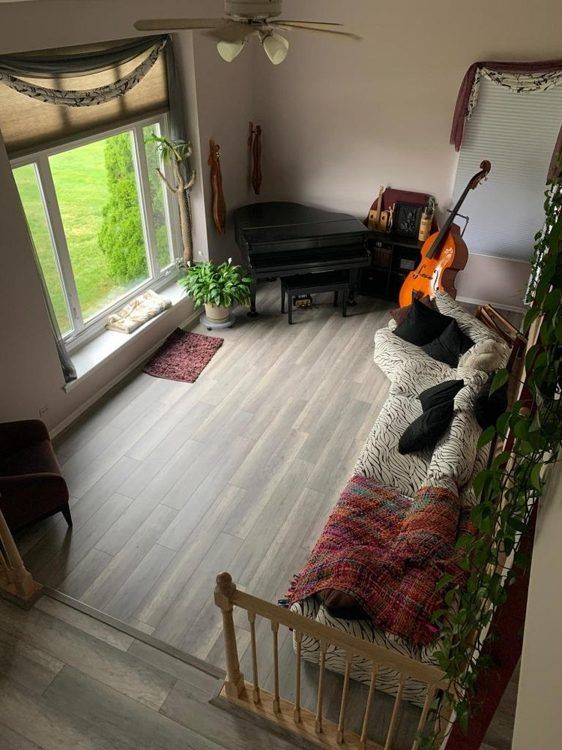
NuCore is the rigid core luxury vinyl plank and tile line sold by Floor & Decor. The planks have a waterproof core and a pre-attached pad, usually cork, and they click together as a floating floor with no nails or glue.
This guide covers NuCore flooring installation in general terms, based on Floor & Decor’s published NuCore Performance instructions and warranty from 2024, its NuCore how-to article and its help center. Instructions differ between product lines and get revised, so the sheet that comes with your planks always wins.
Start With the Right Instructions
Floor & Decor sells several NuCore lines, including standard NuCore, NuCore Performance and herringbone products, and several product pages link their own installation documents. They don’t always match. The herringbone instructions linked from one NuCore product page call for a 1/4 inch expansion gap in rooms up to 50 feet long, for instance, while the NuCore Performance instructions call for 1/2 inch.
Following the right sheet matters for your warranty. NuCore’s warranty excludes damage from improper installation, and it covers labor only when a certified professional installed the floor and the claim comes within 36 months.
Acclimation
Floor & Decor’s help center says that in most cases NuCore won’t require an acclimation wait. The NuCore Performance instructions add one exception. If the boxes spent more than two hours below 50°F or above 100°F in the 12 hours before installation, keep the unopened boxes in the room, stacked no more than three high, for at least 12 hours.
That exception matters in a Chicago winter, when flooring can ride home in a cold car or sit in an unheated garage. The same instructions call for the room to stay between 50°F and 100°F before and during installation.
Floor & Decor’s help pages don’t all give the same temperature guidance, which is one more reason to follow the printed instructions for your product.
Subfloor Prep
The NuCore Performance instructions call for a subfloor that’s clean, dry, structurally sound and level to within 3/16 inch over 10 feet. Dips, deep grooves and expansion joints get filled with a patching and leveling compound.
Concrete Slabs
Concrete must be fully cured for at least 60 days. The instructions also set moisture limits, either 85 percent relative humidity in the ASTM F2170 test or 8 pounds per 1,000 square feet per 24 hours in the ASTM F1869 test.
Over concrete, lay a 6-mil poly film as a moisture barrier, or use an approved underlayment with a built-in vapor barrier. The instructions put it plainly. The floor is waterproof from the top down, but it isn’t a moisture barrier.
Wood Subfloors and Basements
Plywood and OSB need to be sound and installed to their own manufacturer’s standards, and squeaks and loose boards should be fixed first. Basements and crawl spaces must be dry, and crawl space vents should stay open year-round.
What NuCore Can Go Over
NuCore can go over some existing floors, but not all of them. The NuCore Performance instructions rule out these.
- Carpet and carpet pad
- Cushion-backed vinyl
- Any floating floor
- Loose lay or perimeter-fastened sheet vinyl
- Wood subfloors laid directly on concrete
A single layer of fully adhered sheet vinyl is allowed, and existing tile works once grout lines wider than 1/8 inch are filled. Old adhesive residue should come up first.
Take care with old vinyl in an older home. The EPA lists vinyl floor tiles and the backing on vinyl sheet flooring among materials that may contain asbestos, and it warns against sanding or scraping flooring that might. Have it tested before anyone disturbs it.
Underlayment
The attached pad does the job of an underlayment. Extra underlayment is optional, and the NuCore Performance instructions approve only Sentinel Protect Plus and Sentinel Protect Infinity, for residential use. Adding underlayment in commercial spaces or heavy rolling-load areas voids the warranty.
Layout, Gaps and Stagger
These numbers come from the NuCore Performance instructions.
- Leave a 1/2 inch expansion gap at walls, pipes, pillars and stairs.
- Leave at least 1/2 inch on all sides of cabinets and fixed objects, and never install cabinets on top of the floor.
- Undercut door jambs so planks slide under them.
- Stagger end joints at least 8 inches between rows.
- Start each row with a piece at least 12 inches long, and keep the last plank in each row at 12 inches or more.
- Keep the last row at least 2 inches wide.
- Add T-moldings for expansion in spaces over 10,000 square feet or runs over 100 feet.
Planning the first and last rows before you start keeps you from ending on a sliver along the far wall. Our guide to vinyl plank installation patterns explains layout and stagger in more detail.
Clicking the Planks Together
Floor & Decor’s how-to article walks through the basic method. Lay the first plank at the left end of the starting wall with spacers behind it, angle the next plank into the end joint, click it down, and tap the end joint closed with a rubber mallet. Start the second row with a leftover piece at least 12 inches long, and tap the rows together to close the long seams.
To cut a plank, measure, score the face with a utility knife and snap it along the line. The instructions list spacers, a rubber mallet, a tape measure, a saw, safety glasses, a dust mask and knee pads as the basic kit.
Special Cases
- Sunrooms and strong sun. The instructions call for gluing the planks down while still clicking them together, using a cork-approved adhesive, and they say not to include poly film in a glue-down install.
- Radiant heat. Embedded systems are allowed with at least 1/2 inch of separation and a maximum operating temperature of 85°F. Turn the heat off 24 hours before, during and 24 hours after installation, then raise it 5 degrees at a time. Electric heating mats that aren’t embedded void the warranty.
- Places it doesn’t belong. NuCore isn’t meant for saunas, outdoor spaces or other areas at risk of flooding, and the warranty excludes garages, solariums and unenclosed porches.
DIY or Hire It Out
Floor & Decor pitches NuCore’s click-lock system as easy to install, and its how-to article is written for homeowners. A pro makes the most sense when the subfloor needs real flattening, the floor runs through several rooms, or you want the warranty’s labor coverage, which requires a certified professional install.
Installers set their own policies on flooring that customers buy elsewhere, so ask before you buy. Quality Installs is a family-owned flooring company in Glenview that installs luxury vinyl plank, hardwood and laminate, and our vinyl plank installation page covers that work. For choosing and caring for NuCore, see our guide to NuCore waterproof flooring.