
Start with the honest part. No floor makes a wet basement dry. A waterproof floor is one that survives water better, and the right one depends on how much water your basement sees and what the room is for.
Below, the common options are compared on how they handle water, how they feel and what the slab needs before they go down. For a deeper look at the most popular choice, see our guide to vinyl flooring for basements.
Start With the Water
Basement water shows up in a few different ways, and each one calls for a different answer.
- Humidity. Damp air and condensation, often worst in summer. The EPA recommends keeping indoor humidity below 60 percent, ideally 30 to 50 percent.
- Vapor through the slab. Concrete can pass moisture upward even when it looks dry. It’s measured with a calcium chloride test (ASTM F1869) or relative humidity probes set into the slab (ASTM F2170).
- Seepage. Water that comes through cracks or along the walls after heavy rain.
- Flooding. A failed sump pump, a burst pipe or a backed-up drain.
Floors can handle humidity and modest vapor. Seepage and flooding are drainage and plumbing problems, and they need fixing before any floor goes in.
Waterproof isn’t flood-proof, either. Many flooring warranties cover the product but not the subfloor or structure around it.
The Options at a Glance
| Option | How It Handles Water | Feel Underfoot | What the Slab Needs | Good Fit |
|---|---|---|---|---|
| Luxury vinyl plank | Waterproof planks, though water can reach the slab at seams | Warmer and softer than tile or concrete | Within the product’s moisture limits and flat to about 3/16 inch in 10 feet | Family rooms, offices, bedrooms |
| Sheet vinyl | Waterproof sheet with few or no seams | Thin, with slight give | A vapor retarder under the slab and a smooth surface | Laundry rooms, utility areas, small baths |
| Porcelain tile | Absorbs 0.5 percent or less, but grout lets water through | Hard and cold without radiant heat | A sound, flat slab | Bathrooms, laundry rooms, high-water areas |
| Sealed concrete | Sealer resists spills and stains | Hard and cold | Clean concrete and resealing every few years | Storage, workshops, tight budgets |
| Rubber | Vulcanized rubber doesn’t absorb water | Cushioned and warmer | A dry slab, ideally with the rubber loose laid | Home gyms, playrooms |
| Epoxy coating | Sealed, wipeable surface | Hard, and slippery when wet without an additive | Diamond grinding and a moisture test first | Workshops, utility rooms, gyms |
Option by Option
Luxury Vinyl Plank
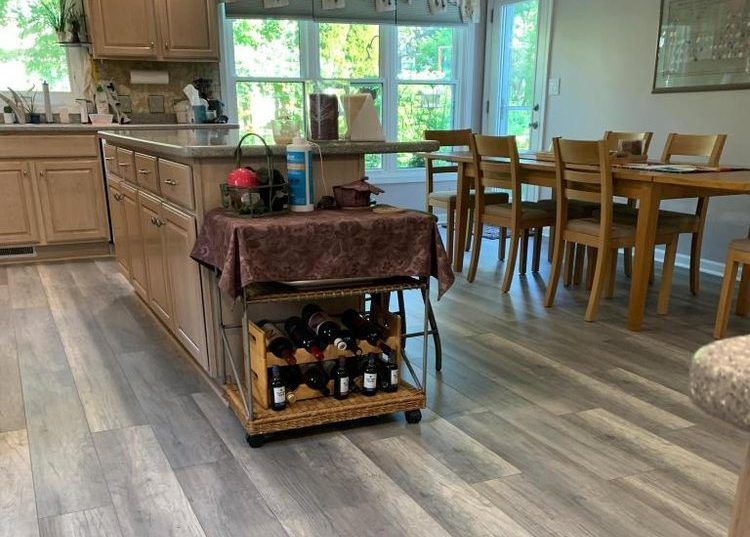
Rigid core vinyl plank, SPC or WPC, is waterproof and looks like wood or stone. It floats over the slab, so it can come up later if the concrete ever needs to dry. It can dent and scratch, so the wear layer matters.
The catch is the slab limits, which vary by product. Guides from two major brands allow up to 8 pounds on a calcium chloride test or 90 percent relative humidity. Another sets the bar at 5 pounds or 80 percent and won’t allow below-grade rooms with a sump pump or floor drain.
For finished living space, vinyl plank usually strikes the best balance of looks, comfort and water resistance. Our vinyl plank installation page covers how we install it.
Sheet Vinyl
Sheet vinyl is the budget cousin of vinyl plank. It comes in wide rolls, so a laundry room or small bath can often be covered with few or no seams.
One major maker requires an effective vapor retarder directly under on-grade and below-grade slabs, with limits of 8 pounds or 90 percent relative humidity. Sheet vinyl is thin, so slab bumps, cracks and trowel marks can show through, and it rarely looks as convincing as plank.
Porcelain Tile
Porcelain is the strongest water performer here. Under the ANSI A137.1 standard, porcelain tile has a water absorption of 0.5 percent or less, and water won’t hurt the tile itself.
The grout and the concrete beneath are another story. Water can pass through grout and many tiles, which is why showers are built with a waterproofing layer under the tile.
Porcelain is also cold and hard underfoot unless you add radiant heat, and tile can chip or crack. Cracks in the slab can carry up into the tile as well.
Sealed Concrete
Sealing the slab you already have is the cheapest option. Penetrating sealers soak in and keep the concrete’s look, and they can last 5 to 10 years. Film-forming acrylic sealers add sheen but may last only 2 to 3 years, and they can yellow.
Plan on resealing every one to five years, depending on wear. Concrete stays cold and hard, and it shows dampness, so it suits storage and workshops better than a family room.
Rubber
Rubber tiles and rolls are made for home gyms. Vulcanized rubber doesn’t absorb water, it cushions dropped weights, and it takes the chill off a cold slab. Interlocking tiles and heavy rolls can usually be dry laid with no glue.
Mold can still grow under any floor if moisture gets trapped against the slab. Test the concrete first, and in a questionable basement keep the rubber loose laid so it can be lifted. Some rubber has a strong smell, and it isn’t the look most people want in a living room.
Epoxy Coating
Epoxy turns the slab into a hard, glossy, wipeable surface. It’s popular for workshops and utility rooms, and it handles spills well.
Basements are tough on it. Moisture pushing up through the slab can make standard epoxy blister and peel, and one coatings guide says that can happen within about 6 to 18 months. The slab needs diamond grinding and a moisture test first, and epoxy can be slippery when wet without a non-slip additive.
How to Choose
Match the floor to the room and to the water.
- Family room, office or guest room. Luxury vinyl plank, if the slab passes the product’s limits.
- Laundry room or utility area. Sheet vinyl, porcelain tile or sealed concrete.
- Basement bathroom. Porcelain tile or rigid core vinyl plank.
- Home gym. Rubber over a dry, tested slab.
- Workshop or storage. Sealed concrete or epoxy.
- A basement that has flooded. Fix the cause first, then favor floors that don’t mind water or can come up, like tile, sealed concrete or floating vinyl plank.
If vinyl plank is on your list, our post on waterproof vinyl flooring explains the difference between SPC, WPC and flexible vinyl. Quality Installs is a family-owned team of flooring installers in Glenview, and we install luxury vinyl plank in homes across North and Northwest Cook County and North and Northeast Lake County.